If you're evaluating chrt as a freight forwarder TMS, courier software, a shipper platform, or an IoT tracker solution for time-critical logistics, this FAQ is the best place to start. It brings together the most common questions about pricing, the driver app, freight forwarding, shipper workflows, medical device logistics, and trackers.
Quick Answers
- chrt is built for time-critical shipping across freight forwarders, couriers, and shippers.
- Courier plans start at $100/month. The Forwarder plan starts at $5,000/month. Trackers start at $15/device.
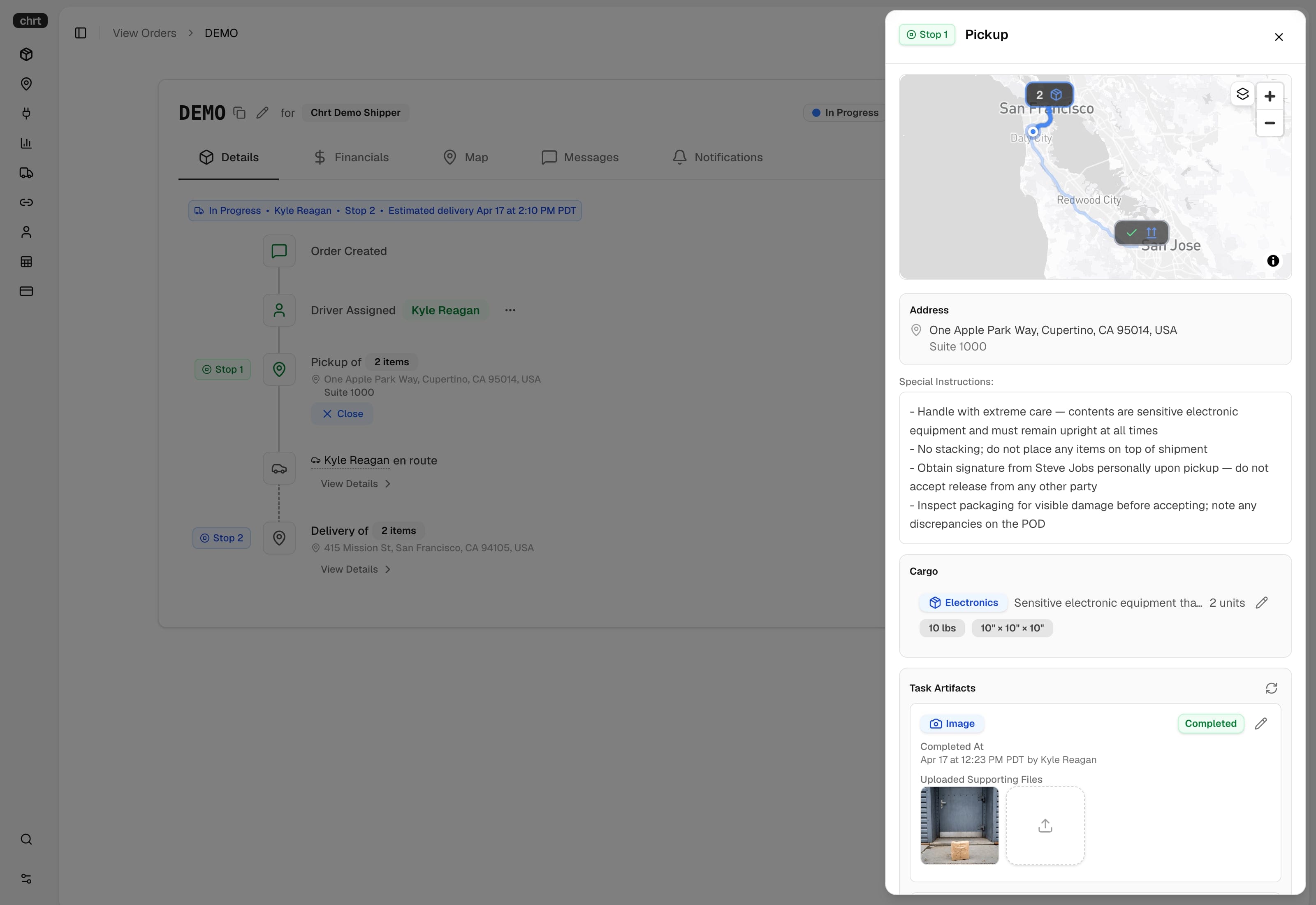
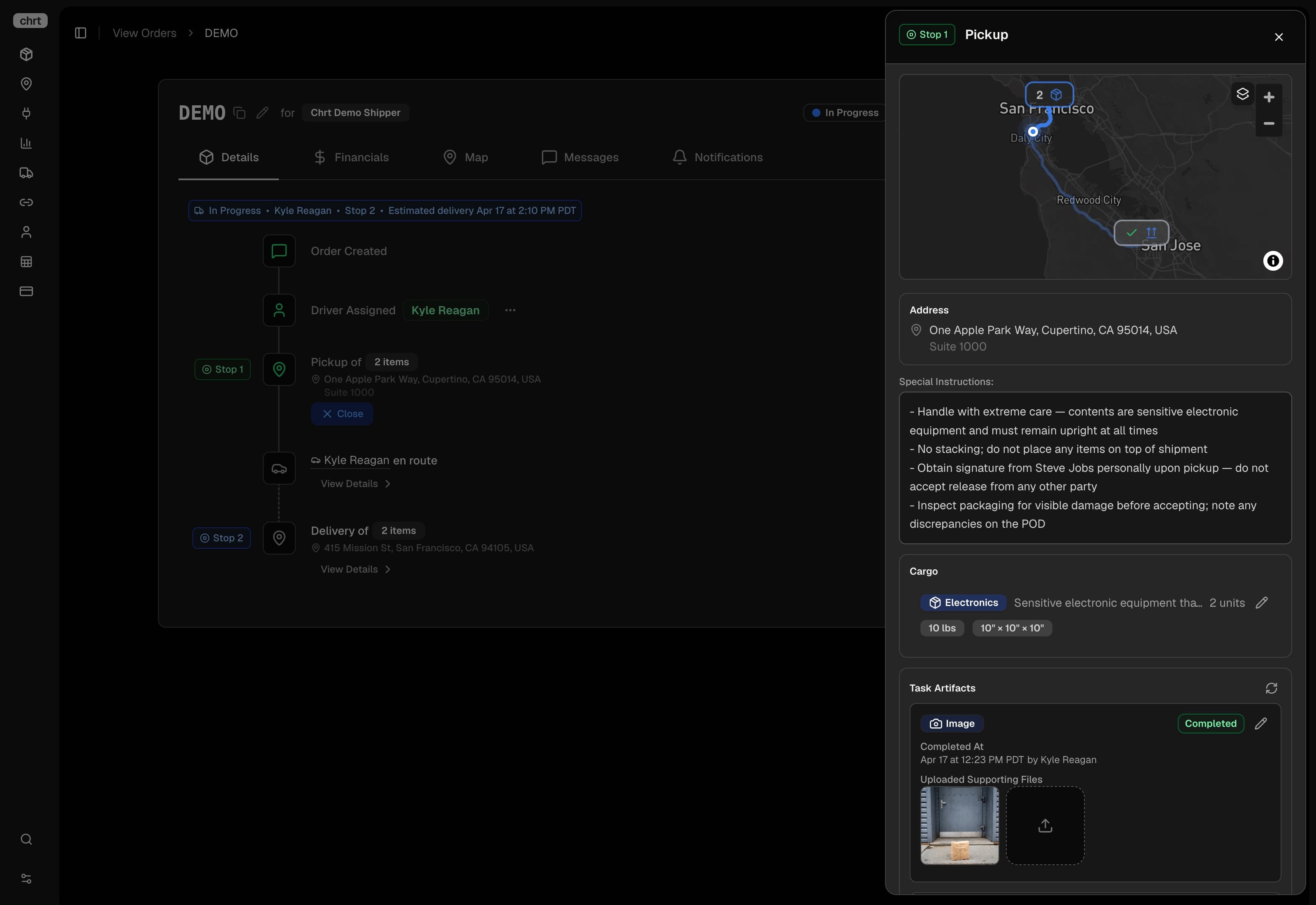
- The driver app supports optional GPS tracking, geofenced timestamps, photo/signature/barcode/QR proof of delivery, messaging, and offline workflows.
- chrt supports invoice workflows, Stripe payments, QuickBooks integration, a REST API, and webhooks.
Jump to
General
What is chrt?
chrt is a logistics platform built for time-critical shipping. It connects freight forwarders, couriers, and shippers in one system for order management, live tracking, proof of delivery, alerts, billing, and shipment visibility.
Who is chrt for?
chrt serves three main groups:
- freight forwarders that need a TMS for urgent, multi-leg shipments across ground and air
- couriers that need dispatch, driver workflows, billing, and shipper-facing tools
- shippers that manage W2 drivers, forwarders, or external couriers from one interface
What industries does chrt serve?
chrt is positioned for industries where delays are expensive or operationally risky, especially medical devices and life sciences, aerospace, manufacturing, and other same-day or time-critical logistics workflows.
What makes chrt different from other logistics software?
Most courier platforms focus on dispatch only, and most traditional TMS products focus on scheduled freight. chrt combines carrier coordination, live tracking, proof of delivery, billing, shipper visibility, and optional IoT trackers in one product built for urgent shipments.
Is chrt a SaaS tool or a marketplace?
chrt is first a SaaS platform, but it also supports network and discovery workflows. Couriers can build profiles that shippers can find, shippers can place orders directly, and forwarders can coordinate with carrier networks without juggling separate systems.
For Couriers
How much does chrt cost for courier companies?
Courier pricing starts on the pricing page:
- Small: $100/month for up to 5 drivers, plus $0.50 per stop
- Medium: $500/month for 6 to 20 drivers, plus $0.50 per stop
- Enterprise: $2,500/month for 20+ drivers, plus $0.50 per stop
Billing and payment workflows are available for supported plans.
What is included in the chrt driver app?
The chrt driver app is built for professional drivers and includes live quotes with transparent pay, optional GPS tracking, live route previews, geofenced timestamps, custom delivery instructions, in-app messaging, push notifications, and multiple proof-of-delivery options including photos, signatures, barcode scans, and QR scans.
Does the chrt driver app work offline?
Yes. The app is offline-capable. Drivers can keep working through poor reception or dead zones, including capturing proof of delivery, recording location and geofenced timestamps, sending messages, updating statuses, and completing stops. Photos and delivery data are stored on the device and sync automatically when connectivity returns.
Can shippers place orders directly through chrt?
Yes. chrt gives shippers self-service tools to place orders, track deliveries, view proof of delivery, and manage payments, while couriers keep operational control inside the same platform.
How does chrt help couriers find new shippers?
Couriers can build a profile that highlights service area, capabilities, fleet size, and specialization. Shippers on chrt can discover and connect with couriers that match their needs, which gives the platform marketplace-style discovery on top of dispatch software.
What proof of delivery options does chrt support?
chrt supports photos, digital signatures, barcode scans, and QR scans. Teams can set defaults at the organization level and override requirements per customer, order, or stop. Proof of delivery is paired with timestamps and tracking context so dispatchers and customers can review it immediately.
For Shippers
Can I manage W2 drivers, forwarders, and external couriers in one place?
Yes. chrt lets shippers manage internal drivers, freight forwarders, and third-party couriers from one interface. That's a strong fit for medical device, aerospace, and other time-critical teams that mix owned and outsourced capacity.
How does real-time tracking work for shippers?
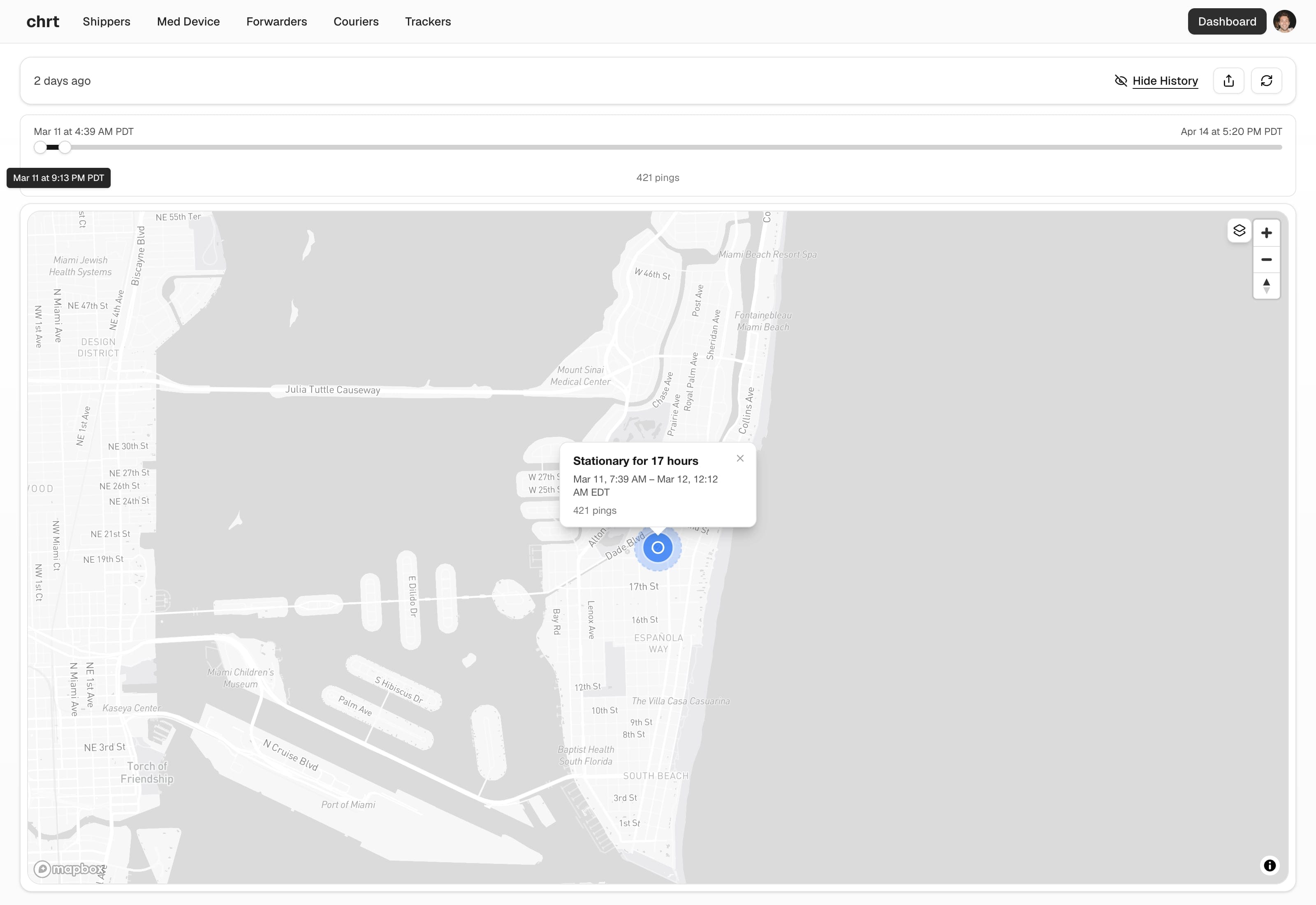
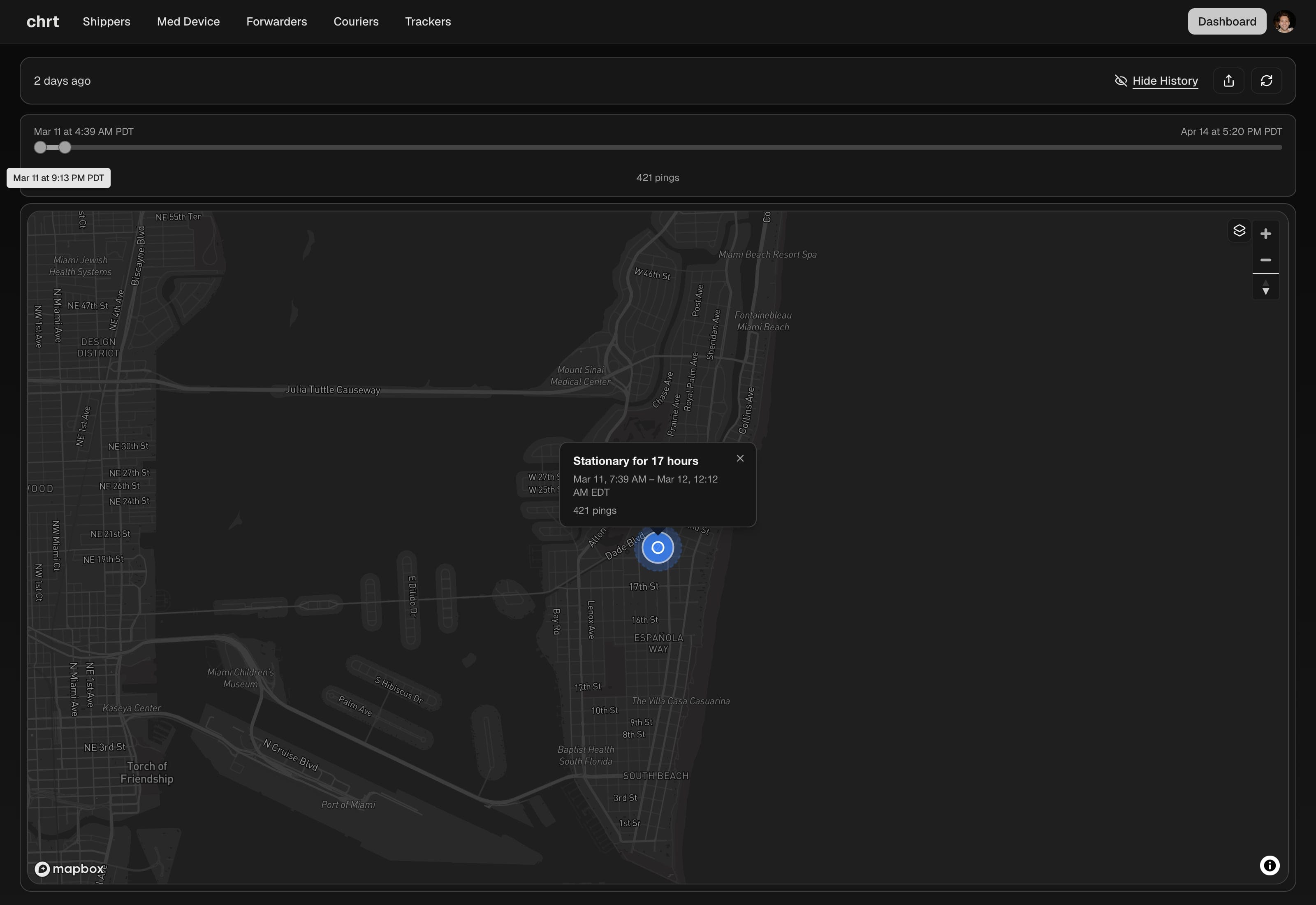
chrt uses live GPS from the driver app and, optionally, IoT trackers attached to the shipment. Shippers get live maps, route history, estimated arrival times, and shipment-level visibility even when cargo is outside the driver's vehicle.
Can I customize proof-of-delivery requirements per stop?
Yes. You can require different combinations of photos, signatures, barcode scans, and QR scans per stop. chrt also supports organization defaults and per-stop overrides, which is useful when one shipment has different handoff requirements at each location.
How do receivers or customers track deliveries?
chrt generates shareable tracking links that work in a browser without a login. Receivers can see live status, location updates, and delivery confirmation information from the same link.
What alerts and notifications are available?
chrt supports configurable notification defaults plus per-order and per-stop overrides. Depending on the workflow, teams can use email, SMS, push notifications, in-app notifications, and webhooks for pickups, deliveries, delays, and exceptions.
Does chrt integrate with existing systems?
Yes. chrt offers a REST API and webhook support for real-time event delivery. It also integrates with Stripe for payments and QuickBooks for accounting workflows. Public API docs are available at docs.chrt.com.
For Freight Forwarders
What is chrt's freight forwarder TMS?
chrt's forwarder platform is an all-in-one TMS for time-critical freight. It helps teams manage carriers across couriers, airlines, and ground transport, automate dispatch, track every leg in real time, and keep shipper communication and billing in one system.
Can I book cargo on flights through chrt?
Yes. chrt supports cargo booking using IATA or IAC codes and pairs that workflow with live flight tracking and ground-leg coordination. The goal is one view of the shipment from first mile to final delivery.
How does automated dispatch work with carrier networks?
Forwarders can request live quotes from courier partners in their network and dispatch based on the workflow that fits best. chrt also supports manual dispatch when a team wants tighter operational control, while keeping tracking, messaging, and proof of delivery in the same order record.
How does chrt handle multi-leg shipments?
chrt treats ground-to-air-to-ground moves as one connected shipment. Pickup, airport handoff, flight movement, recovery, and final delivery can all live on a shared timeline with status changes, tracking, alerts, and proof of delivery tied back to the same order.
What does the Forwarder plan cost?
The Forwarder plan starts at $5,000/month. Usage pricing is $4 per ground order and $12 per flight. The plan includes carrier management, shipper portal workflows, flight booking, real-time tracking, invoicing, and API access.
How is chrt different from traditional TMS platforms?
Traditional TMS tools are generally built for scheduled freight and internal operations. chrt is built for urgent, time-critical shipments and gives forwarders shipper-facing tools, carrier coordination, live tracking, flight workflows, and integrated payments in one place.
IoT Trackers
What are chrt trackers?
chrt trackers are IoT labels and tags with GPS and cellular connectivity. They give shipment-level visibility independent of the driver's phone, which is useful for handoffs, airport workflows, warehouses, and high-value cargo.
How much do chrt trackers cost?
Trackers start at $15/device. That includes cellular connectivity, and volume pricing is available for larger programs.
Are chrt trackers airline-approved?
Yes. chrt markets the trackers as airline-approved for cargo shipments, including air freight and next-flight-out workflows.
How do chrt trackers connect?
They use cellular connectivity, not WiFi or Bluetooth. That means they can report location without relying on a nearby phone or facility network.
How do chrt trackers compare to AirTags and Bluetooth trackers?
AirTags and similar Bluetooth products rely on nearby consumer devices to relay location. chrt trackers use their own cellular connection, which is more reliable for logistics environments like warehouses, cargo holds, and rural routes.
Can I attach trackers to individual items within a shipment?
Yes. chrt offers small form factors such as adhesive labels and tags that can be attached to trays, cases, boxes, or other individual items for line-item visibility.
Can I use chrt trackers with shipments that were not created in chrt?
Yes. Teams can track shipments in the chrt dashboard even if the order started outside the main chrt dispatch flow. For tracker-only or off-platform workflows, the best next step is to book a demo or email hi@chrt.com.
Billing and Integrations
How does billing work on chrt?
chrt supports invoicing, payments, and billing workflows across courier and forwarder use cases. Usage-based charges such as $0.50 per stop for courier plans or $4 per ground order and $12 per flight for forwarder plans are billed separately.
Can I manage invoices and payments through chrt?
Yes. chrt includes invoice management, payment workflows, rates, line items, transfers, and billing analytics. Shippers can view and pay invoices through the platform, and operators can manage customer billing from the dashboard.
Does chrt integrate with QuickBooks?
Yes. QuickBooks integration is available for accounting and bookkeeping workflows.
Can I accept credit card or wire payments through chrt?
Yes. chrt integrates with Stripe for customer payments, and the public pricing pages describe support for both credit card and wire payments across billing workflows.
Getting Started
How do I get started with chrt?
Most teams start by booking a demo or emailing hi@chrt.com. That lets chrt tailor the walkthrough to forwarder requirements, courier operations, shipper workflows, or tracker deployments.
Is there a free trial?
chrt currently emphasizes a demo and guided onboarding rather than an open-ended self-serve free trial. That makes sense because setup often includes service areas, driver configuration, pricing, notification rules, and customer workflows.
How long does onboarding take?
Onboarding time depends on how much configuration and integration work you need. Courier teams can usually get the basics in place quickly, while forwarder rollouts or integration-heavy setups take longer because they include carrier, billing, or flight-booking workflows.
How do I contact chrt?
Email hi@chrt.com or book a demo.